
OL PEJETA CONSERVANCY
The Ol Pejeta Conservancy is a non-profit wildlife conservancy located in Laikipia County, Central Kenya, covering an area of 360 km (140 sq mi). It is located between Mount Kenya and the Aberdares foothills on the equator, west of Nanyuki. In addition to protecting wildlife and offering a haven for great apes, the Ol Pejeta Conservancy makes money from wildlife tourism and related businesses that it then reinvests in conservation and community development.
In 2013, the Conservancy achieved a population milestone of one hundred eastern black rhinos, making it the largest black rhinoceros sanctuary in East Africa. The two last northern white rhinos in the world are also kept there; they were relocated from the Czech Republic’s Dvůr Králové Zoo.The only location in Kenya where chimpanzees can be seen is the Sweetwaters Chimpanzee Sanctuary, which serves as a sanctuary for rescued, abandoned, and orphaned chimpanzees. Along with a wide variety of other African animals, the Conservancy is home to the “Big five game.” Additionally, it runs a livestock program that benefits wildlife and pastoralists in the area. Ol Pejeta gives money to local communities through its community development program to support infrastructure, water, education, and health initiatives. Additionally, they support the growth of community-based conservation tourism initiatives as well as the delivery of extension services related to agriculture and livestock.
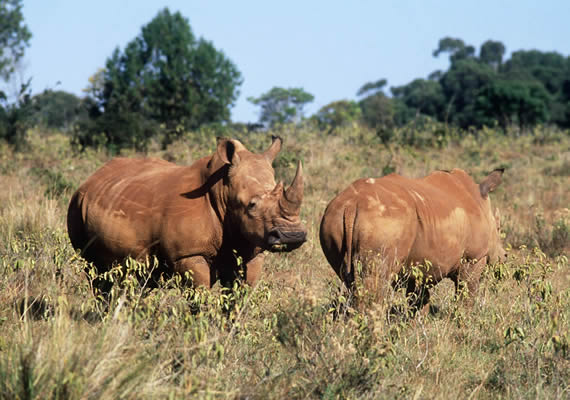 The Ol Pejeta Conservancy is home to the “Big five game”—the lion, Cape buffalo, African bush elephant, African leopard, and rhinoceros. Here, black and white rhinos flourish. Ol Pejeta documented the birth of its 100th black rhino in 2013. According to the IUCN African Rhino Specialist Group, the Conservancy’s black rhino population is now classified as a “Key 1” population. Only eight sanctuaries in Africa hold this distinction.
The endangered African wild dog, oryx, Jackson’s hartebeest, Grevy’s zebra, serval, cheetah, and bat-eared fox are among the other uncommon creatures that can be found on Ol Pejeta. Giraffes, vervet monkeys, baboons, hippos, impala, eland, Grant’s gazelle, dik-dik, plains zebra, silver-backed jackal, and hyena are among the more common African wildlife that can be found there. The Conservancy is home to more than 300 different species of birds.
Specially designed game corridors allow all animals to enter and exit the Conservancy freely, with the exception of rhinos. Elephants, antelope, and carnivores can easily jump or step over knee-high posts in the ground that are placed very close to one another. But because rhinos can’t do this, they can’t go into places where they could be poached for their horn.
Northern White Rhinos
There are only five rhino species left, including the northern white rhino. The northern whites, which resemble their southern white cousin, were severely impacted by the poaching epidemic in the 1980s and early 1990s and are now thought to be extinct in the wild. On December 20, 2009, four of the seven rhinos that were still in captivity moved to Ol Pejeta. In the hopes that the climate and lush grasslands of Ol Pejeta, the animals’ natural habitat, would offer them better breeding conditions, two males and two females were relocated from the Czech Republic’s Dvůr Králové Zoo.
The 700-acre enclosure and round-the-clock armed security were provided for the males (called Sudan and Suni) and females (called Fatu and Najin). Tests have shown that Suni is not pregnant, despite the fact that she was spotted mating with Najin in 2012. To preserve northern white rhino genetics in hybrid offspring, Ol Pejeta is attempting to crossbreed the closely related southern white rhinos with the northern white rhinos. Suni passed away on October 17, 2014, from unspecified causes—not poaching. Sudan was put to death on March 19, 2018, due to “age-related complications.”